
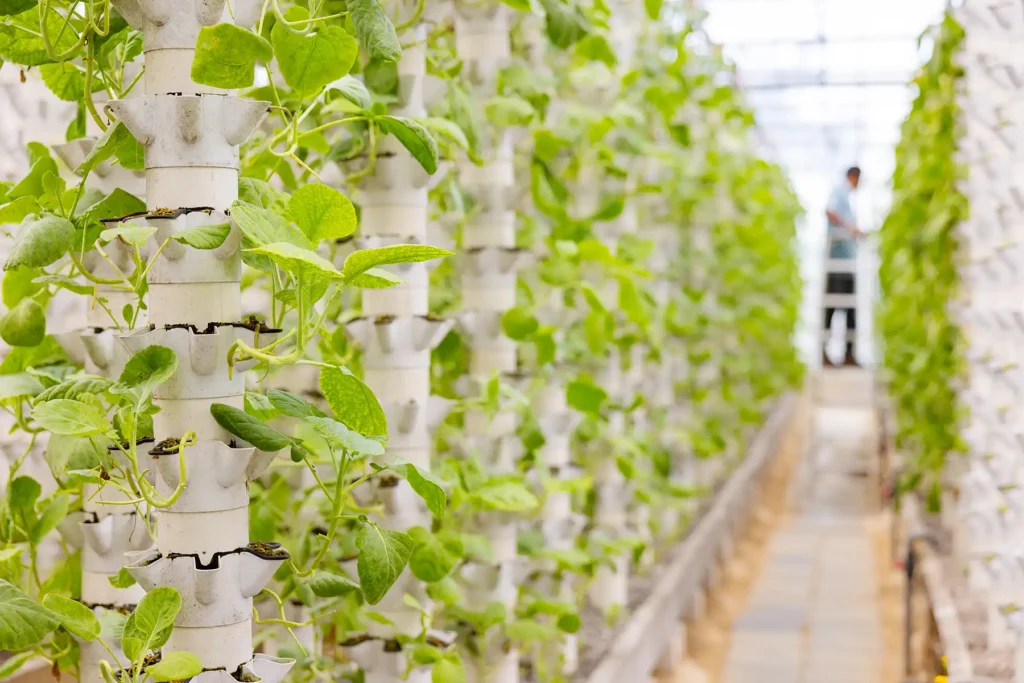
As global challenges such as climate change, population growth, and resource scarcity continue to intensify, the need for a more sustainable approach to agriculture has never been more urgent. Enter vertical farming—a cutting-edge innovation that is redefining the way we grow and consume food. This transformative method of farming holds the promise of solving some of the most pressing issues in agriculture while offering a glimpse into a future where food production is more efficient, eco-friendly, and accessible.
The Traditional Challenges of Agriculture
For centuries, traditional farming methods have dominated the agricultural landscape. However, these methods come with significant challenges:
- Unpredictability: Weather fluctuations, pests, and natural disasters often jeopardize crop yields.
- Resource Constraints: Agriculture accounts for 70% of global freshwater use, and fertile land is becoming increasingly scarce.
- Environmental Impact: Deforestation, soil degradation, and carbon emissions are major byproducts of traditional farming.
- Supply Chain Vulnerability: Dependence on global logistics leaves food systems exposed to disruptions caused by pandemics, geopolitical conflicts, or natural disasters.
The cumulative effect of these challenges underscores the urgent need for a more resilient and sustainable food system—and vertical farming provides just that.
What is Vertical Farming?
Vertical farming is the practice of growing crops in vertically stacked layers, often within controlled indoor environments. Utilizing advanced technologies such as hydroponics, aeroponics, and artificial lighting, vertical farms create optimal conditions for plants to thrive, independent of external environmental factors. This method not only maximizes land use but also ensures consistent, year-round food production.
Key Benefits of Vertical Farming
- Maximized Space Efficiency By growing crops vertically, this approach dramatically increases the amount of food that can be produced per square foot of space. This makes it particularly valuable in urban settings where land is limited and expensive.
- Water Conservation Vertical farming uses up to 95% less water than traditional farming methods, thanks to closed-loop hydroponic and aeroponic systems that recycle water and nutrients. This is a game-changer in a world where freshwater resources are dwindling.
- Energy Efficiency Advanced technologies, such as Power over Ethernet (PoE) lighting, optimize energy use, making vertical farming up to 40% more energy-efficient than conventional methods. Customizable lighting spectrums also ensure plants receive the exact wavelengths needed for optimal growth.
- Reduced Environmental Impact Without the need for pesticides or herbicides and with significantly lower carbon emissions due to localized production, vertical farming offers a more sustainable alternative to traditional agriculture.
- Year-Round Production Controlled Environment Agriculture (CEA) ensures that crops are grown in stable conditions, unaffected by seasons or weather. This guarantees a consistent supply of fresh, nutrient-rich produce.
Addressing Global Food Security
By 2050, the global population is expected to exceed 9 billion, necessitating a 70% increase in food production. Vertical farming has the potential to bridge this gap. Its ability to grow food locally reduces reliance on global supply chains, minimizes transportation costs, and ensures fresher produce reaches consumers.
For example, vertical farms in urban areas can supply nearby communities with high-value crops such as leafy greens, herbs, and strawberries, reducing the distance food travels from farm to table. This not only cuts down on food waste but also lowers carbon emissions associated with transportation.
Real-World Success Stories
- Singapore’s Sky Greens: As one of the world’s first commercial vertical farms, Sky Greens produces up to 10 times more vegetables per unit area than traditional farms.
- Bowery Farming in the U.S.: Utilizing AI-driven technology, Bowery Farming delivers pesticide-free produce to local markets with incredible efficiency.
- Recline Ridge in Vernon, BC: Leveraging PoE lighting and advanced grow modules, Recline Ridge demonstrates how vertical farming can be scaled to address food security while supporting local economies.
The Road Ahead
While vertical farming is not without its challenges—such as high initial setup costs and energy demands—ongoing advancements in technology and economies of scale are rapidly addressing these issues. As more governments, businesses, and communities invest in vertical farming, its adoption is expected to grow exponentially.
Conclusion
Vertical farming represents a revolutionary shift in agriculture, offering a sustainable and scalable solution to feed a growing global population. By maximizing resource efficiency, minimizing environmental impact, and ensuring food security, vertical farming is not just the future of food—it’s the future of our planet.